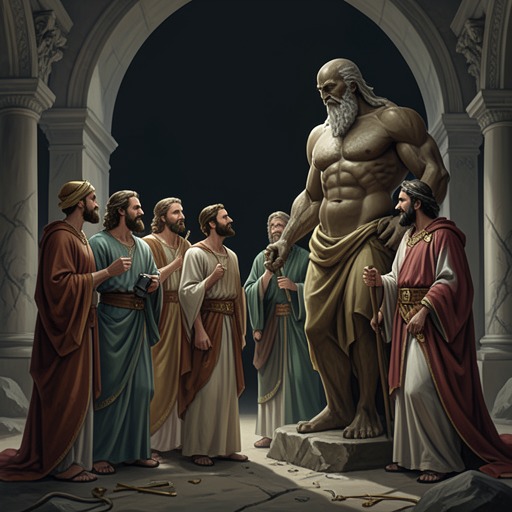
Muar’s Ascension
Systema Delenda EstMuar’s Ascension is the moment when Muar crosses from Alum-ranked advancement into genuine divinity by his own effort rather than through an imposed status, a quest reward, or another deity’s sponsorship. He does not merely gain power: he converts his entire System-granted existence into the role of Deity, carrying his Domain, Estate, Interface, items, and accumulated identity across the boundary into the Divine Realm. The event resolves his deepest dependence on the System by transforming devotion into self-authored authority, and it immediately places him beside Misse Eln as one of the decisive powers in the struggle over the System’s future.
Background and Religious Commitment
Muar’s ascent is prepared by an unusually intense attachment to the System as both institution and source of meaning. When he first reaches a temple on Uriva, a world populated largely by insect-people, he experiences the temple’s atmosphere as a return from exile. The System-less space he remembers had seemed to him like a blank, silent void: without status, progress, or the ability to understand and interact with the world, existence appeared dead and purposeless. Inside the temple, by contrast, the presence of the divine System soothes him as though it were restoring reality itself.
That need is not merely emotional. Muar spends days meditating and communing with the System crystal, seeking a Skill through devotion rather than through an ordinary drop. The effort earns him the Divine Insight Skill, reinforcing his belief that advancement can be a sacred relationship rather than only an economic or military process. His later conversion therefore follows a consistent religious logic. He does not regard the Divine Realm as a prize to be seized by any available shortcut; he wants to understand it deeply enough to enter as a peer.
The Deliberate Path Across the Boundary
By the time of the ascension, Muar is Alum-ranked and already possesses Chosen status and Skills that could let him enter the Divine Realm. He rejects that route as hollow because it would supply the appearance of strength through outside forces, much as Cato’s agents receive power without necessarily understanding the condition they occupy. Muar has seen deities who simply assume their status, whereas he considers Misse Eln’s understanding of the distinction between mortal and divine existence more authentic. His objective is not to be admitted as a favored exception but to cross the boundary through his own essence.
Several possible paths are closed because of choices made during his rise, yet Muar does not regret those choices. He selects the most difficult remaining method: breaking through by commitment and will, without the support of a quest or even the assistance of his favored status. His prior experience of the Divine Realm gives him a point of reference. He remembers how it felt to ordinary senses and to the more esoteric senses of his Domain, whose divine aspect is connected to the fundamental nature of the System.
Rather than forcing himself upward in isolation, Muar attempts to make his Domain correspond to the Divine Realm. He suffuses his entire Estate with that Domain, merging personal essence with the Domain and attuning the combined structure to something higher. The requirement is comprehensive. His Estate, Interface, granted items, and trophies must all be shifted into the role of Deity; leaving them behind would make the passage incomplete. This is why he meditates at home instead of in a temple. The transformation must encompass the whole System-shaped structure of his existence, not only the consciousness housed inside it.
The Ascension and Conversion
The threshold appears first as a barely perceptible instability. Muar’s surroundings flicker as he brings his essence into closer alignment with the reality above his ordinary world. He senses that the destination exists just beyond the reality he knows, then makes a final adjustment and a push in an indescribable direction. The movement is neither ordinary travel nor a conventional teleportation. It is a change in ontological position: Muar becomes capable of sensing beyond the surface of Misse’s personal world and suddenly arrives in the Divine Realm.
The System confirms the achievement by asking whether he will convert to Deity. Muar accepts without hesitation. Unknown chains fall away, his essence expands into the Divine Realm, and the limitations that had defined his previous status vanish. Strands of the divine realm settle around him, while the core crystal of his Estate contracts to the size of a badge and attaches itself to his armor and to him. The crystal links into his soul, illuminating the expanding constellation of connections that spreads from the locations of his Skills.
The change is therefore both liberation and reclassification. Muar has not simply added a higher rank to an existing character sheet. His Estate, its Interface, and the essence that constituted his System identity are reorganized as components of divine being. The System records the conversion as complete and passes the Crusader Title to designated inheritors before welcoming him as Deity Muar. The title transfer marks a material consequence of the transformation: a former role tied to his prior state is no longer his to retain, while the new divine status is formally recognized.
Recognition as Overdeity
After the conversion, Muar opens his eyes inside his Estate, now enclosed in a self-contained bubble of reality. A personal sun shines overhead, a breeze moves through the bright blue walls, and the Estate has become an autonomous divine space rather than merely an advanced personal residence. With a flicker of will, he appears at its edge and creates a doorway outward. The marbled blue arch reveals a field of lights representing the System’s connected worlds, linked by streams of essence.
Misse Eln is waiting on the other side. She greets him with evident satisfaction, taps the Deity badge on his chest, and the Interface announces his promotion as Overdeity Muar. The wording establishes a distinction between the initial conversion notice, which names him a Deity, and Misse’s subsequent recognition of the greater authority he now occupies. His ascent thus has two stages: an inward conversion accomplished through his own will, followed by an external political and theological acknowledgment from the ruler who already controls the True Core.
The relationship between Muar and Misse also clarifies the practical consequence of the event. Misse considers Muar the only person firmly on her side—not merely aligned with her clan or with senior gods, but personally committed to her representation of the System. Muar’s devotion is directed primarily toward the System itself, yet that devotion makes Misse the most worthy representative in his judgment. Once he becomes a Deity, his loyalty is no longer only private conviction; it becomes a source of institutional support for Misse at the center of System power.
Consequences and Narrative Significance
Muar’s Ascension contrasts sharply with the System’s unstable and coercive forms of divine authority elsewhere. The True Core prohibits combat Skills in its vestibule, and access to its inner regions is restricted to a small subset of beings with divine affinity. Authority is therefore spatially organized: the closer a deity’s world is brought to the Core, the more essence and access become available. Muar’s successful crossing places him within this hierarchy not as a passive beneficiary but as someone who has learned to reproduce the transition through disciplined alignment of self, Domain, and Estate.
The event also throws Cato’s position into sharper relief. Misse discovers that, despite her expanded access to the True Core, none of Cato’s works or presence can be found within the Interface’s reach. Cato is therefore not merely a rival deity operating under another factional title; he stands outside the System’s categories in a way Muar does not. Muar’s ascent strengthens the System’s side of the conflict precisely because it is an authentic internal transformation, while Cato’s power remains defined by his refusal to belong to the System at all.
That contrast matters politically as well as metaphysically. Marus Eln and Initik can suspend traffic to and from Sydea by divine authority, and Misse can summon the heads of the Nine Great Clans while declaring that the System, rather than the clans, must become the focus of collective action. Such acts reveal a regime increasingly governed through emergency powers and claims of sacred necessity. Muar’s ascent gives Misse another committed divine ally at the moment when the System’s authority is under direct threat. His personal breakthrough consequently becomes part of the larger struggle over who may define the System, who may speak for it, and whether devotion to its order can survive Cato’s campaign against it.